Abrasive Nylon Filaments: Can Engineered Bristles Really Replace Traditional Abrasives in Wood and Floor Finishing?
For decades, wood finishing and floor care relied on a straightforward principle: abrasive paper or cloth makes contact with the surface, removes material, and gets replaced when worn. Sanding discs, belts, and sheets dominated workshops and job sites. But this approach has inherent limitations—consistent pressure is difficult to maintain, complex profiles are hard to reach, and backing materials clog quickly when finishing resinous woods or coated surfaces.
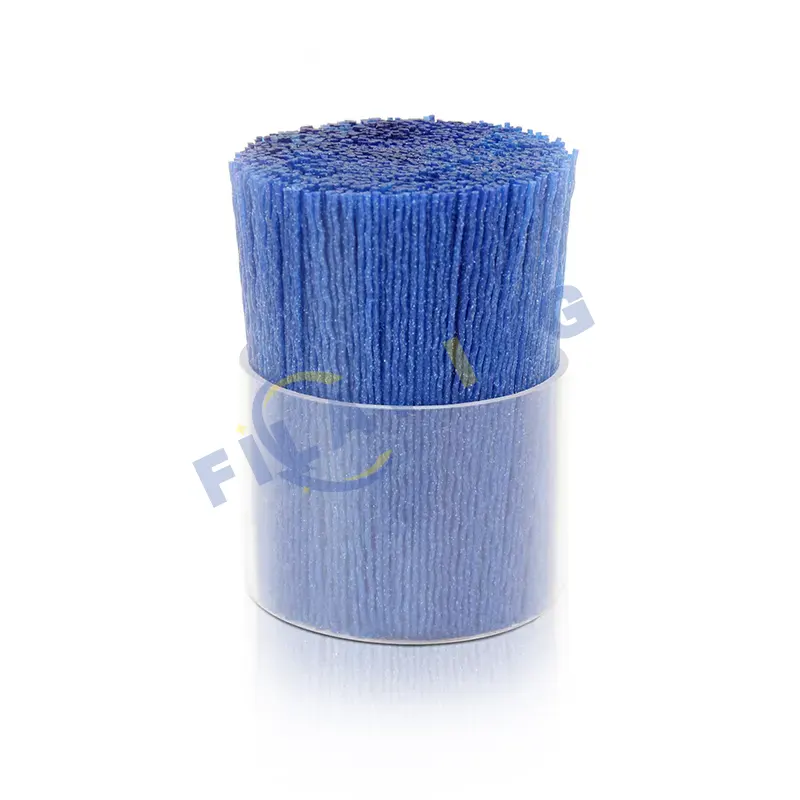
Abrasive nylon filaments have emerged as an alternative technology that challenges these limitations. Unlike coated abrasives that present a fixed layer of grit on a paper or cloth backing, abrasive nylon filaments embed abrasive particles—aluminum oxide, silicon carbide, ceramic, or diamond—directly into nylon monofilaments. These filaments are then tufted into brushes that conform to surface contours, provide consistent cutting action over extended periods, and resist loading from soft materials.
The Technology: How Abrasive Nylon Filaments Work
A conventional abrasive brush wears down and exposes new grit as the nylon matrix erodes. This is not a flaw—it is the design principle. An abrasive nylon filament consists of a nylon base polymer (typically PA6, PA610, or PA612) with abrasive particles uniformly dispersed throughout the filament cross-section. As the brush operates, the nylon wears away at a controlled rate, continuously exposing fresh abrasive particles.
Key Parameters
Three variables define the performance of any abrasive nylon filament:
Grit size : Ranges from coarse (46 grit) to fine (500 grit and beyond). Coarser grits remove material faster; finer grits produce smoother finishes.
Abrasive loading : The percentage of abrasive particles within the filament by weight, typically 25% to 30% for most applications. Higher loading increases cutting action but may reduce filament flexibility and fatigue life.
Filament diameter : Ranges from 0.4 mm to 1.6 mm. Thicker filaments are stiffer and more aggressive; thinner filaments conform more readily to complex contours and produce finer finishes.
Filawing manufactures abrasive nylon filaments across the full spectrum of these parameters, allowing customers to select the combination suited to their specific application.
The German Production Line Advantage
The 2010 acquisition of a complete automatic production line and technology from Germany shifted Filawing from generic filament extrusion to precision manufacturing. German-engineered extrusion equipment provides tighter diameter tolerances, more consistent abrasive dispersion, and higher throughput. For a product where a 0.1 mm diameter variation changes brush stiffness and surface finish, extrusion precision directly affects customer outcomes.
Aluminum Oxide Filaments: The Workhorse for Wood and Floor Care
Aluminum oxide is the most widely used abrasive mineral in woodworking. It is tough, fractures under pressure to create fresh cutting edges, and offers a good balance between cutting speed and finish quality. Filawing's aluminum oxide abrasive nylon filaments are specifically formulated for two major applications.
Wood Sanding Applications
Aluminum oxide abrasive nylon filaments are used to manufacture sanding brushes for wood finishing across multiple product categories:
- Hardwood flooring: Sanding brushes prepare floor surfaces between coating layers, removing nibs and creating mechanical adhesion. Consistent finishing performance across large floor areas requires uniform abrasive action.
- Flat packed furniture: Edge sanding and surface preparation before finishing.
- Veneer panels: Delicate sanding where excessive heat or pressure would burn through the thin veneer layer.
- Cabinet doors: Profile sanding where brushes conform to raised panels and routed details.
- Frames and molded products: Intricate profiles that cannot be effectively sanded with flat abrasive sheets.
The abrasive nylon filament brush conforms to the workpiece surface, maintaining contact even when the part geometry varies. For molded products with compound curves, this conformity is difficult or impossible to achieve with rigid sanding tools.
Specifications for wood sanding:
| Parameter | Range |
|---|---|
| Grit size | 46 – 240 |
| Abrasive loading | 25% – 30% |
| Filament diameter | 0.6 mm – 1.6 mm |
| Color | Natural |
Silicon Carbide Filaments as an Alternative
For certain wood sanding applications, customers choose silicon carbide filaments instead of aluminum oxide. Silicon carbide is harder and sharper than aluminum oxide but more friable (it fractures more readily). The choice depends on the wood species, coating type, and desired finish. Filawing produces both, allowing customers to test and select the optimal abrasive nylon filament for their specific wood type and finishing line.
Floor Care Brushes
Floor care brushes made with aluminum oxide abrasive nylon filaments are cost-effective products for stripping floors and aggressive scrubbing procedures. These brushes are used in commercial floor maintenance equipment to:
- Remove old floor finish (wax or urethane coatings) before reapplication
- Aggressively scrub concrete or terrazzo floors before sealing
- Prepare floors for recoating without wet chemistry
For polishing applications, Filawing notes that brushes made with smaller abrasive filaments mixed with tampico (a natural fiber from the Agave plant) are sometimes used. The tampico provides additional flexibility and mild abrasion while the abrasive nylon filaments provide cutting action.
Specifications for floor care:
| Parameter | Range |
|---|---|
| Grit size | 46 – 500 |
| Abrasive loading | 25% – 30% |
| Filament diameter | 0.4 mm – 1.6 mm |
| Color | Natural |
The wider grit range (up to 500) reflects the distinction between aggressive stripping (coarse grit) and final polishing (fine grit). The minimum filament diameter of 0.4 mm allows very fine finish quality on sensitive floor surfaces.
Filament Materials: PA6, PA610, PA612
produces abrasive nylon filaments in three distinct nylon grades, each offering different performance characteristics.
PA6 (Nylon 6) : The most common nylon filament base. Offers good abrasion resistance, reasonable water absorption (which can affect dimensional stability in humid environments), and excellent toughness. Suitable for general-purpose abrasive nylon filaments where cost is a primary consideration.
PA610 (Nylon 6/10) : Lower moisture absorption than PA6, better dimensional stability in varied environmental conditions. Used when filament properties must remain consistent across changing humidity levels—relevant for export shipments crossing climate zones or applications in unconditioned manufacturing spaces.
PA610 (Nylon 6/12) : Even lower moisture absorption than PA610, with improved chemical resistance. The premium choice for abrasive nylon filaments operating in wet environments or where exposure to cleaning chemicals is expected.
The availability of multiple nylon bases allows filament brush manufacturers to select the material that best matches their operating environment. A floor care brush used in a wet scrubbing application requires different nylon chemistry than a wood sanding brush operating with dust extraction.
Material Supply Chain: Diamond Grits from a Global Leader
The quality of abrasive nylon filaments depends entirely on the quality of the abrasive particles embedded within them. Filawing's diamond grits supplier is Henan Huanghe Whirlwind Co., Ltd., one of the largest synthetic diamond manufacturers in the world, with an annual output of 2.4 billion carats of synthetic diamond grits, supplying approximately 30% of the global market.
This supply relationship matters for customers who require diamond abrasive nylon filaments. For stone processing, ceramic finishing, and hard metal applications, diamond is the abrasive of choice. A filament supplier without access to high-quality diamond grits cannot produce diamond abrasive nylon filaments that compete with established sources. Filawing's partnership with a top-tier diamond supplier provides that capability.
For non-diamond abrasives, Filawing cooperates with well-known domestic raw material suppliers, maintaining a quality control system that extends to incoming material inspection before filament extrusion begins.
Expanded Product Range: Beyond Aluminum Oxide
Over its two decades of operation, Filawing has expanded its abrasive nylon filament portfolio to serve multiple industries beyond wood and floor care.
| Abrasive Type | Primary Applications |
|---|---|
| Diamond filaments | Natural stone (granite, marble), ceramic tile, hard metal, glass |
| Silicon carbide filaments | Non-ferrous metals, titanium, composites, wood (profile sanding), paint removal |
| Aluminum oxide filaments | Wood, floor care, ferrous metals, paints, coatings |
| Ceramic filaments | High-pressure grinding, stainless steel, nickel alloys |
This range of abrasive nylon filaments positions Filawing as a full-line supplier rather than a single-material specialist. Customers in automotive manufacturing, metallurgy, hardware production, textile operations, and industrial cleaning all fall within the addressable market.
Production Capacity and Expansion
Filawing's abrasive nylon filaments production line has expanded to three lines, with the addition of one bristle cutting machine production line. The bristle cutting line represents a downstream integration step—rather than selling only filament spools to brush manufacturers, Filawing can now supply cut-to-length bristles ready for tufting into finished brushes.
Expanded production capacity ensures that large-volume customers receive consistent supply without gaps. For manufacturers integrating abrasive nylon filaments into their brush production lines, supply interruptions are costly. Filawing's multiple production lines provide redundancy and capacity headroom.
Export Markets and Quality Control
Filawing's abrasive nylon filaments are sold in several provinces within China and exported to Europe, America, Southeast Asia, South Africa, and Brazil. Exporting to diverse markets requires attention to regional quality expectations and documentation requirements.
The company operates a complete and scientific quality control system within its 3,000+ square meter modern factory. While specific certifications (ISO, REACH, RoHS) are not listed in available information, Filawing states that it has a "complete and scientific quality control system" and focuses on customer requirements, continuously improving and updating products through technology and raw material development.
Market Position and Competitive Strategy
The abrasive nylon filaments market includes established global players with decades of history. Filawing competes by focusing on customer requirements rather than attempting to match incumbents across all dimensions simultaneously.
Under fierce market competition , the company states that it adheres to its original intention, striving for steady improvement in quality and professional service to every customer. This positioning emphasizes flexibility and responsiveness, distinguishing Filawing from larger competitors that may prioritize standard products over customization.
For customers requiring specific grit, diameter, or loading combinations in their abrasive nylon filaments, a manufacturer willing to adjust parameters without punitive lead times or minimums offers material value.
Key Takeaways
- Product category: Abrasive nylon filaments — nylon monofilaments with embedded abrasive particles (PA6, PA610, PA612 series)
- Manufacturer: Filawing Industry Co., Limited — professional manufacturer in China since 2006
- German production line: Full set of automatic equipment and technology imported from Germany in 2010
- Abrasive types: Diamond, silicon carbide, aluminum oxide, ceramic
- Aluminum oxide applications: Wood sanding (hardwood flooring, flat furniture, veneer panels, cabinet doors, molded products) and floor care (stripping, aggressive scrubbing, polishing with tampico mix)
- Grit range: 46 – 500; loading: 25% – 30%; diameter: 0.4 mm – 1.6 mm
- Diamond grit supply: Henan Huanghe Whirlwind Co., Ltd. (2.4 billion carats/year, 30% global market share)
- Facility: 3,000+ square meters; three filament lines; one bristle cutting line
- Export markets: Europe, America, Southeast Asia, South Africa, Brazil
- Target industries: Natural stone, automobile, metallurgy, hardware, textile, cleaning, wood finishing, floor care